



Saturday, 28 April 2012


Friday, 27 April 2012
Lack Of Time Is No Excuse Not To Exercise | Athletes And Celebrities Get Fit In 4 Minutes With Tabata Training
Another article showing that Tabata training is well known and used in Hollywood:
Wednesday, 25 April 2012
Henry Cavill: "Immortal" Superman also used Tabata training!
It sounds like the Tabata training became a "must do" for Hollywood actors who needs to look muscular but lean for their roles. What do you think?
TeenHollywood: Can you talk about bulking up for this film?
Henry: It was a martial arts base training and tabata training (high repetition circuit training) which tends to be hard repetitions of body weight exercises with 25 repetitions of say press ups, followed by eight deep breaths, followed by 25 ab exercises, followed by something else and was one round. And then you have to do four rounds of that. Your recovery is eight breaths. It was [going for] a very lean as opposed to a bulky ripped, physique. Very low on carbs. A lot of meat and fish but no starchy carbs.
Full article here:
http://www.teenhollywood.com/2011/11/07/henry-cavill-immortal-supermanTeenHollywood: Can you talk about bulking up for this film?
Henry: It was a martial arts base training and tabata training (high repetition circuit training) which tends to be hard repetitions of body weight exercises with 25 repetitions of say press ups, followed by eight deep breaths, followed by 25 ab exercises, followed by something else and was one round. And then you have to do four rounds of that. Your recovery is eight breaths. It was [going for] a very lean as opposed to a bulky ripped, physique. Very low on carbs. A lot of meat and fish but no starchy carbs.
Full article here:
More about his Tabata training:

Sunday, 22 April 2012
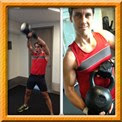
Hollywood star Chris Hemsworth’s Thor workout uses Tabata training!
In this article, you can understand better how to incorporate the Tabata training into your regimen. This is interesting to see that Tabata training is used in a second phase (after phase 1 or bulking / building mass muscles) to get lean, keep strong muscles.
Official Chris Hemsworth Thor workout
Circuit one - Tabata (20sec on/10sec off): - Double kettlebell squats - four rounds
- Eight rounds of snatches - eight rounds
Friday, 6 April 2012
Check the eBook on Google Docs!
You can read the complete eBook "How to Perform the Tabata Training" following this link:
DOWNLOAD THE EBOOK FOR FREE
DOWNLOAD THE EBOOK FOR FREE

Thursday, 5 April 2012
Conclusion, how to perform the TABATA Training
5) Conclusion
To
perform the Tabata training:
1.
Pick-up
an exercise (sprint, cycling, hills, treadmills, thruster, front squat,
burpees)
2.
Warm-up
for 5mn at low intensity, with some
accelerations at the end
3.
Perform
the Tabata : 8 bouts of 20s of efforts, with 10s rest intervals
4.
Use
a watch, smart phone with apps, MP3, or a partner to respect the protocol
5.
Cool
down for 5mn (total rest for 1mn or 2mn until you catch your breath and 2-3mn
low intensity exercise).
That’s
it!
Include 2 to 3 sessions per week,
according to your regular training. For endurance sport, like triathlon, you
can select running, cycling or swimming as it will also strengthen your usual routine.
For martial arts and MMA, front squat or thruster are good choices, along
punching ball or jumping rope. For fitness and lose control, any exercise
practiced regularly will help you to burn calories.
How to schedule TABATA training?
d.
How
to schedule
This is important to know how to
schedule your sessions of Tabata training and to adjust the periodicity with
your actual training plan and objectives.
i. During preparation period
Using
Tabata training to prepare the season makes sense. If you apply the 5 sessions
a week, and you can gain 14% of VO2Max and 28% of anaerobic capacity like the
sample people during the initial protocol, it’s a whooping result. However it’s
probably very hard to be able to stick to the plan. Most of the positive
results were gained during the first 4 weeks; therefore it might be sufficient,
especially if you complete the protocol with classic training.
In
my case, for Triathlon preparation, I try to perform at least Tabata training
at least once in a week, either by running, cycling or sometimes thruster.
Choice
of exercise matters. As we seen, if you are into martial arts or combat sports,
using punching ball or jump rope is something already incorporated in your
training regimen. If you are a triathlete, running, cycling and swimming are
usual. The advantage of doing Tabata with weights, like front squat or
thruster, can bring double benefit: working your muscles at a high intensity
and cardio strength.
ii. Savy time
If you plan 5mn of warming-up, 4mn for
Tabata work out and 5mn of cooling down, it’s only 15mn and it’s more efficient
than one hour of endurance training at 70% of VO2max (as per initial Tabata
study). Therefore, it’s a perfect sessions to include in your schedule, at
lunch time of after work, when time is scarce. Some people recommend to train
in the morning, when still fasting, and burn more fat, but it will require a
very high level of motivation to push you hard enough to reach the intensity
required (remember, 170% of VO2Max?).
4) How to incorporate Tabata protocol in your training regimen? c. Fitness & lose weight
c.
Fitness
& lose weight
If your goal is to lose weight (fat),
to gain muscles, to be athletic, to have a better shape, to feel more
energetic, Tabata training is a good option. The results are amazing and it’s a
time saver. The most appropriate exercise, if you can access to a gym, will be
treadmill, cycling, thruster, jumping box*, front squat. If you train at home,
running outside or on hills, burpees, thruster with water bottle will be a good
choice.
*use 2 or 3 steppers, and perform
jump, then go back to the floor, and start again. Be careful about stability
and having proper sport shoes to amortize the choc on the floor. Excellent
exercise, combining strength cardio and plyometric, but stay careful about your
knees.
If you can access to a CrossFit club,
you will see that Tabata is a very popular regimen in their schedule. Lots of
feed-back on tips on their website & forums: www.crossfit.com or more specifically www.crossfitendurance.com
In term of lose fat, a lot of studies
tend to demonstrate that HIIT training is more efficient than regular, low
intensity endurance exercises:
-Impact of exercise intensity on body fatness and
skeletal muscle metabolism.
http://www.ncbi.nlm.nih.gov/pubmed/8028502
-High-intensity intermittent exercise and fat loss.
http://www.ncbi.nlm.nih.gov/pubmed/21113312
Another very good training in HIIT,
different from Tabata (10 x 4mn cycling at 90% VO2max):
A 8s/12s for 20mn description and also
confirming again than HIIT is better than aerobic:
Losing fat means losing weight,
therefore for running specifically, you can benefit from Tabata training to
combine the improvement of VO2max and losing weight:
Be aware that genetics could be
involved, whether you are respondent or not t this kind of HIIT training! Check
this link from BBC : http://www.bbc.co.uk/news/health-17177251
4) How to incorporate Tabata protocol in your training regimen? b. Endurance sports
b.
Endurance
sports
i. Running
As we mentioned earlier, sprinting is
one of the best exercise for Tabata. It might seem a paradox but sprinting will
help you to improve your endurance. Tabata can be used as a time saver, and
also to exercise different muscles fibers than the typical endurance sessions.
Tabata will not replace steady
endurance training for marathon for instance. It’s however an exercise you can
include in your preparation schedule.
As stated by Dr. Pat O’Shea:
“Coaches
and athletes need to understand however, that short-term intense interval
training has very limited application to long-distance events such
as marathon running and the Tour de France. Long distance endurance athletes
need efficient "fat burning" bodies. Their muscles must be trained to
utilize energy from free fatty acid oxidation while conserving the limited
stores of glycogen which are necessary for nerve and brain function. (Nerves
and the brain derive energy only from glycogen - not fat.)” .
Some others think differently: “In the old days, before sports
nutrition was taken seriously, athletes used to train to burn fats for energy.
Compared to carbohydrate, our body's fat reserves are vast. Training the body
to burn fats for energy is time consuming, as it involves lots of long, slow
distance training. If you are short of time you must look for a different
solution”. (Source: http://www.metasport.com/cycling-for-busy-people.php)
ii. Triathlon
Triathlon
is an endurance sport, but Tabata can be beneficial.
“MacKenzie
trains a number of triathletes and incorporates stationary-bike and treadmill
Tabata sessions into the program of all who are willing to endure the suffering
these workouts entail. An ultra-runner himself, MacKenzie credits his own
twice-weekly Tabata sessions with enabling him to improve his performance on a
training schedule averaging only 6.5 hours per week, and he says his triathlete
clients have reported similar benefits.”
More about MacKenzie and CrossFit
Endurance: http://www.crossfitendurance.com/about-2/
Another testimony from Lisa Barnes (USAT Level 1
coach and an Ironman athlete):
http://lavamagazine.com/training/tabata-training-for-triathletes/#axzz1evbGXEXr
http://lavamagazine.com/training/tabata-training-for-triathletes/#axzz1evbGXEXr
However in her article, I don’t see
the “Iron Man” training with biceps curls and triceps extension soliciting
enough muscles to reach the Tabata intensity.
In short, Tabata for triathlon can be
highly beneficial, as a time saver, and practicing swimming, cycling or
running.
It’s no use to try the Tabata training
before or after a long classic endurance session; you will need a couple of
hours to recover and to benefit from the method.
About swimming, it’s pretty difficult
to manage exactly the 20s work /10 s rest, but you can try something
approaching. For instance, if you can cover the 25m of lap pool in 18s (free
style), taking only 10s rest before heading back should be sufficient. The last
bouts will be probably done at a pace over the initial 20s, because of the
exhaustion. Be careful; don’t be alone in the swim pool if you try such a high
intensity. Safety first. May be the butterfly swim is a good option, especially
if your technique is not perfect, you will spend a lot of energy and you will
have a chance to reach the intensity required by Tabata training (remember,
170% of VO2max?).
4) How to incorporate Tabata protocol in your training regimen? a. Martial arts
4) How to incorporate Tabata protocol in
your training regimen
a.
Martial
arts
i. Taekwondo: mondolyo
Taekwondo is very famous for its
kicks, spinning, jumping etc. It was called “flying karate” before becoming
more popular than Karate itself. The
“Mondolyo Tchagi” is one of the best techniques for applying Tabata principles.
To avoid vertigo, I strongly advised to change the direction of the spin at each
kick, and adding a “step” to switch your legs. If a partner can handle the
target for you, it’s a perfect choice because he will help you to monitor the
time and to count the number of kicks you can execute. Be careful to warm up
and to stretch enough before performing the kick. You need to have a certain level to master
this kick and to fully benefit of the Tabata training. From my point of view
(as a black belt 4th degree), I would advise to be at least red
belt, or to have some experience in competition.
Other alternatives might include pit
tchagi right/left without stop and as fast possible, with a partner or a
sandbag or equivalent. You can try also
tuio duit dora tchagi (jumped horse kick).
ii. Bear with barbell for MMA
For
MMA (Mixed Martials Arts), it is interesting to combine cardio and strength
training. A “combo” with a barbell, like the “bear” might be a good choice. (http://www.thefitblog.net/2010/05/the-bear-complex-possibly-the-best-full-body-exercise.html).
iii. Punching bag kicks+punches
For contact sport, such a Thai Boxing,
Full contact, French Savate etc… a work out with punching bag with provide an
intense Tabata workout, especially with combination of punches and kicks.
iv. Jump rope
This is an excellent exercise,
required a limited space and involving lower and upper body muscles. To reach
the 170% of VO2Max, you will probably need to jump with two feet at the same
time, either with a very high speed or jumping high, or make a “double under”
(the rope passes twice under your feet). A loaded handgrip might help to make
the exercise harder as well.
Subscribe to:
Posts (Atom)